Showing posts with label dk photonics. Show all posts

Friday, November 22, 2013

What is Passive Optical Network?


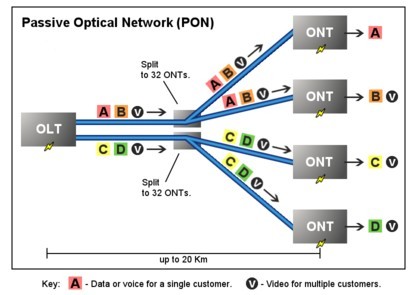
Passive Optical Network (PON) is a form of fiber-optic access network that uses point-to-multipoint fiber to the premises in which unpowered optical splitters are used to enable a single optical fiber to serve multiple premises. A PON system consists of an OLT at the service provider's central office and a number of ONU units near end users, with an ODN between the OLT and ONU. PON reduces the amount of fiber and central office equipment required compared with point-to-point architectures.
PON Optical Network
Passive Optical Network (PON)
The most obvious advantage of the PON network is the elimination of the outdoor active devices. All the signals processing functions are completed in the switches and the user premises equipment. The upfront investment of this access methods are small, and the most funds investment is postponed until the user really access. Its transmission distance is shorter than the active optical access system. The coverage is also smaller, but it is low cost, no need to set the engine room, and easy to maintain. So this structure can be economically serve for the home users.

PON Development Background

Seen from the entire network structures, due to the larger numbers of laying optical fibers, and widely applications of DWDM technology, the backbone network has been a breakthrough in the development. The same time, due to advances in Ethernet technology, its dominant LAN bandwidth has increased from 10M, 100M to 1G or 10G.. At present, what we are concerned about is the part between the network backbone and local area networks, home users; this is often said that the "last mile", which a bottleneck is. Must break this bottleneck, may user in the new world of the online world. It is as if in a national highway system, trunk and regional roads have been built in the broad high-grade highway, but leads to the families and businesses of the door was still narrow winding path, the efficiency of the road network cannot play.

Saturday, August 3, 2013

The worldwide use of fiber optic circulators is expected to reach $228.5 million in 2013

ElectroniCast Consultants, a leading market research & technology forecast consultancy addressing the fiber optics communications industry, today announced the release of a new market forecast of the global consumption of fiber optic circulators in optical communications.
During 2012-2017, the value is forecast to increase at an average annual growth rate of 8.4 percent.  The consumption value is forecast to increase with rising quantity growth partially offset by declining average prices.
The fiber optic circulator market is presented by the following port-count configurations: 3 – Ports; 4 – Ports; and more than 4 - Ports (> 4 - Ports).  According to ElectroniCast, the total consumption value of fiber optic circulators is expected to reach $228.5 million in 2013.  3-Port fiber optic circulators are expected to hold an estimated 80% market share in 2013.  Well-over 70% of the 3-Port fiber optic circulator market value in 2013 is used in Telecommunication applications.
Telecommunications is set to maintain its dominant market share lead throughout the forecast period.  Specialty applications (R&D laboratory, sensors, test equipment, oil/gas, other) are set to maintain the position of second-place, according to the ElectroniCast market forecast and analysis study.
The deployment of optical fiber in the metro/access, the continuing demand for upgrading networks to accommodate rapidly increasing bandwidth requirements, plus the need for additional monitoring and testing of the optical fiber networks will drive the steady consumption of fiber optic circulators.
As terrestrial national backbone and undersea systems approaching Tb/s capacities, advanced fiber-optic components, such as fiber optic circulators, are key in enabling DWDM systems with narrow channel spacing to achieve the large numbers of channels required. Fiber optic circulators are used with erbium-doped fiber amplifiers (EDFA), fiber optic sensor applications, dense WDM (DWDM), optical add/drop multiplexing (OADM), optical time domain reflectometers (OTDR fiber optic test equipment), bi-directional transmission systems, dispersion compensators, and other devices.  
According to ElectroniCast Consultants, 3-Port fiber optic circulators are expected to hold an 80% (value) market share in 2013…
Fiber Optic Circulator Global Market Share (%), By Port Count
(2013 – ElectroniCast Estimate: $228.5 Million)
Image