Monday, October 20, 2014

Introduction of FBG Filter Embedded Adaptor-FBG filters for live network monitoring using in FTTH

Introduction of FBG Filter Embedded Adaptor-FBG filters for live network monitoring using in FTTH
FBG Filter Embedded Adaptor
FBG Filter Embedded Connector
FBG filters for FTTx applications are reflective filters integrated in the LC or SC adapters, which reflect the 1625 nm wavelength and transmit all other (i.e. 1310, 1490 and 1550 nm). They can be used to monitor live network utilizing OTDR operating at 1625 or 1650 nm. End-to-end OTDR measurements from OLT to ONT are typically difficult due to the high point insertion loss introduced by the splitter and due to the required very good spatial resolution. The use of the 1625 nm reflectors is an efficient and cost-effective way of reducing the required dynamic range of the OTDR. The 1625 reflectors  are currently considered the best way of implementing  real time end-to-end (OLT to ONT) monitoring of the optical layer in live FTTx networks.
FBG filter
More information for the FBG Filter Embedded Connector
DK Photonics – www.dkphotonics.com  specializes in designing and manufacturing of high quality optical passive components mainly for telecommunication, fiber sensor and fiber laser applications,such as PLC Splitter, WDM, FWDM, CWDM, DWDM, OADM,Optical Circulator, Isolator, PM Circulator, PM Isolator, Fused Coupler, Fused WDM, Collimator, Optical Switch and Polarization Maintaining Components, Pump Combiner, High power isolator, Patch Cord and all kinds of connectors.

Monday, October 13, 2014

DK Photonics:Huawei to invest over $4 billion in fixed broadband technology in 3 years

Telecom network vendor Huawei on Thursday said it will be investing over $4 billion in fixed broadband (FBB) technology research and development over the next three years.
Huawei’s plans to invest significantly in fixed broadband technology reflects a report from Dell’Oro Group that said wireline telecom markets will grow at a CAGR of 3 percent against 1 percent growth for wireless between 2013 and 2018.
In August, Dell’Oro Group said the combined service provider equipment markets will grow at a CAGR of 2 percent between 2013 and 2018 — after recording a CAGR of -1 percent between 2008 and 2013.
Huawei said the $4 billion investment will focus on products and solutions which will support their customers with providing an improved service experience for end users.
Huawei Products and Solutions President Ryan Ding said: “Our investment will further develop technological advances, help customers increase their competitiveness and decrease overall operating costs.”
Existing technologies are changing, next-generation High-Efficiency Video Coding is maturing, 4k panel and content production costs are reducing and the development of the 4k video industry, are all driving new solutions.
Huawei to invest over $4 billion in fixed broadband technology in 3 years
As LTE and 5G deployment continues, construction of high-performance networks which guarantee better customer experience will be expected by telecom operators. Huawei said FBB technologies will be progressed by leveraging big data, data centers and cloud computing to meet their needs.
Tam Dell’Oro, president and founder of Dell’Oro Group, said: “While we believe carriers will continue to enhance their wireless networks, we anticipate carriers will put more emphasis on backhauling traffic which means improving their fixed line networks in the next five years.”
Huawei today said it will innovate Software Defined Networking (SDN), Network Functions Virtualization (NFV) to initiate open broadband networks that help customers simplify operations and management, realize service innovation and improve network efficiency.
For next-generation networks, Huawei will conduct research and develop on new key technologies and architectures for IP and all-optical networks, advancing FBB network development.
Fixed LTE broadband access gains
At present, 1.26 billion households do not have DSL, cable, or fiber-optic broadband. Fixed and mobile telecoms are looking to LTE to make the connection.
“By the end of 2014, there will be 14.5 million residential and commercial premises with fixed LTE broadband access. By 2019, that figure should grow to 123 million,” said Jake Saunders, VP and 4G practice director at ABI Research.
ITU pitches for broadband
ITU, a telecom industry association under the aegis of UN, says more than 40 percent of the world’s people are already online, with the number of Internet users rising from 2.3 billion in 2013 to 2.9 billion by the end of this year.
Over 2.3 billion people will access mobile broadband by end 2014, climbing steeply to a predicted 7.6 billion within the next five years.
ITU says there are now over three times as many mobile broadband connections as there are conventional fixed broadband subscriptions.
Huawei on green telecom
Meanwhile, Eric Xu, Rotating chief executive officer, Huawei, said: “Huawei is committed to socio-economic and environmental sustainability. We leverage our expertise to bridge the digital divide and deliver high-quality digital connectivity for all.”
“We always honor our commitment to supporting secure and stable network operations anytime, anywhere. We contribute to low-carbon economies by helping customers and industries improve productivity and reduce energy consumption,” said Xu at the sixth Global Supplier Sustainability Conference in Shenzhen, China.
DK Photonics – www.dkphotonics.com  specializes in designing and manufacturing of high quality optical passive components mainly for telecommunication, fiber sensor and fiber laser applications,such as PLC Splitter, WDM, FWDM, CWDM, DWDM, OADM,Optical Circulator, Isolator, PM Circulator, PM Isolator, Fused Coupler, Fused WDM, Collimator, Optical Switch and Polarization Maintaining Components, Pump Combiner, High power isolator, Patch Cord and all kinds of connectors.

Sunday, October 5, 2014

Fiber Optics Sensors Provide Early Warning for Landslides-DK Photonics

CASERTA, Italy, Sept. 29, 2014 — Fiber optic sensors could warn people of imminent landslides, potentially saving lives and reducing destruction.
A team at the Second University of Naples is developing sensor technology that could detect and monitor both large landslides and slow slope movements. The researchers hope to mitigate the effects of these major natural disasters, similar to the way hurricane tracking can prompt coastal evacuations.
Optical fiber sensors embedded in shallow trenches within slopes would detect small shifts in the soil, the researchers said. Landslides are always preceded by various types of pre-failure strains, they said.
While the magnitude of pre-failure strains depends on the rock or soil involved — ranging from fractured rock debris and pyroclastic flows to fine-grained soils — they are measurable. Electrical sensors have long been used for monitoring landslides, but that type of sensor can be easily damaged, the researchers said. Optical fiber is more robust, economical and sensitive.
“Distributed optical fiber sensors can act as a ‘nervous system’ of slopes by measuring the tensile strain of the soil they’re embedded within,” said professor Dr. Luigi Zeni.
The researchers are also combining several types of optical fiber sensors into a plastic tube that twists and moves under the forces of the pre-failure strains. This will allow them to monitor the movement and bending of the optical fiber remotely to determine if a landslide is imminent.
The use of fiber optic sensors “allows us to overcome some limitations of traditional inclinometers, because fiber-based ones have no moving parts and can withstand larger soil deformations,” Zeni said.
He added that such sensors can be used to cover several square kilometers and monitored continuously to pinpoint critical zones.
The team will present their research at Frontiers in Optics in Tucson, Ariz., next month.
DK Photonics – www.dkphotonics.com  specializes in designing and manufacturing of high quality optical passive components mainly for telecommunication, fiber sensor and fiber laser applications,such as PLC Splitter, WDM, FWDM, CWDM, DWDM, OADM,Optical Circulator, Isolator, PM Circulator, PM Isolator, Fused Coupler, Fused WDM, Collimator, Optical Switch and Polarization Maintaining Components, Pump Combiner, High power isolator, Patch Cord and all kinds of connectors.

Thursday, September 25, 2014

Can I use single mode equipment over multimode cable and vice versa?

This is a question we get many times from our customers. Especially common is a situation, in older installations, back to the times when multimode cable was cheaper than single mode, and inside buildings, and some last mile installations were planned so, that multimode cables were laid.
Answer is not that easy, to answer simply yes or no. Let’s delve in a details.
Definitions:
  • SONET – Synchronous Optical Network
  • SMF – SingleMode Fiber
  • MMF – MultiMode Fiber
  • LED – Light Emitting Diode
  • DMD – Differential Mode Delay
  • Mode -
  1. light rays entering the fiber at the particular angle;
  2. paths of different length and transmission delays that travel through the cable.
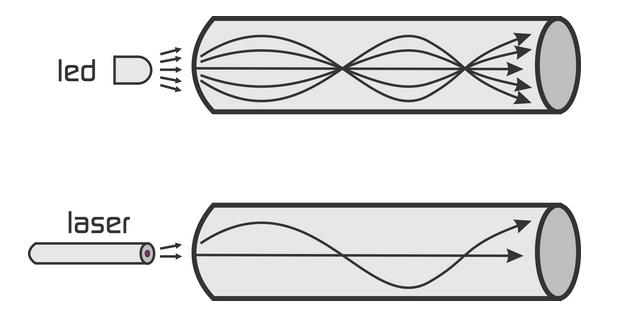
SMF is using laser as a source for the light and therefore light beam is very concentrated. It allows higher bandwidth compared to MMF, while having greater transmission distance.
MMF is typically using LEDs for transmission of the optical signal. It is clear from the name, that it uses multiple modes of light at the same time. Entry angles differ for each mode of the light resulting in different speeds and distances that signal can travel.
single-mode-vs-multimode
Single mode vs Multimode
  1. It is possible to interconnect two devices using SMF interface at one end and MMF receiver at another one. But here, many depends also on devices. Like for example ,more sophisticated routers, like Huawei, Alcatel or Cisco while supporting that at physical layer, will not support it at TA. Problem is in DMD that may occur when two different modes are directly coupled. Degradation of the bandwidth also decreases the distance supported for transmission. Also, SMF transmitter should be calibrated in a way so the SMF signal would not overdrive MMF receiver.
Solution: Using the intermediate switch with SMF and MMF interfaces that is able to convert the signals is a good alternative.
  1. If you use simple devices, such as video over fiber, or media converters, then it depends, what wavelength are used for your equipment. The trick here is that as we know, single-mode fibers used in telecommunications operate at 1310 or 1550 nm and require bit (now only a little bit) more expensive laser sources, and in older equipment MMF wavelength used were 850 nm.
And if you have this kind of transceivers, then it won’t work over your single mode cable. If you have a newer generation media converters, which use 1300 nm lasers, it will most likely work.
Most common wavelengths
Table 1. Most common wavelengths (non WDM, CWDM or DWDM) used in optical transmission systems.
DK Photonics – www.dkphotonics.com  specializes in designing and manufacturing of high quality optical passive components mainly for telecommunication, fiber sensor and fiber laser applications,such as PLC Splitter, WDM, FWDM, CWDM, DWDM, OADM,Optical Circulator, Isolator, PM Circulator, PM Isolator, Fused Coupler, Fused WDM, Collimator, Optical Switch and Polarization Maintaining Components, Pump Combiner, High power isolator, Patch Cord and all kinds of connectors.

Tuesday, September 23, 2014

Fiber Optic Connector Market Forecast-DK Photonics

According to ElectroniCast, multifiber / multichannel fiber optic connectors are set for explosive growth, led by MXC™ fiber connectors with triple-digit increases through 2018…
Aptos, CA (USA) – September 22, 2014 --ElectroniCast Consultants, a leading market & technology forecast consultancy addressing the fiber optics communications industry, today announced the release of their annual market forecast and analysis of the use offiber optic connectors and mechanical splices in communication applications. 
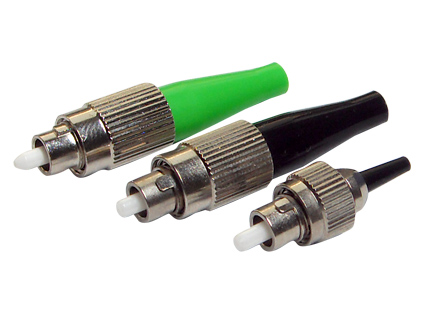
FC fiber optic connector
According to ElectroniCast, the worldwide fiber optic connector/mechanical splice consumption value reached $2.63 billion in 2013.  Multimode fiber optic connectors led the consumption value in 2013 with a 64 percent market share.  The use of multimode fiber optic connectors is forecast to increase at a rate of 14 percent per year, from $1.68 billion in 2013 to $3.24 billion in 2018. 
“The multimode LC small form factor connector is forecast to maintain the leadership position in relative market share throughout the forecast period, as well as increasing at an average annual rate of 20 percent,” said Stephen Montgomery, Director of the Fiber Optic Component group at ElectroniCast. 
The fastest annual growth is set to come from the use of multifiber/multichannel fiber optic connectors are set for explosive growth, led by MXC™ fiber connectors with triple-digit increases through 2018.  The newly-release connector design enables more fibers (up to 64 fibers at 25G) to be accommodated in fast-paced server/storage data center and other applications.  Both the single-mode and the multimode MXC fiber optic connectors are forecast to reach strong values by 2018.  
Other new fiber optic connector designs, besides the MXC connector, are planned for deployment to address the high-density/high-speed data speeds of 25Gbps or greater in the next couple of years.
“Field-installable connectors for indoor and outdoor use are increasing in demand and thus are making a big-splash in the overall connector product lines of several competitors.  Fiber optic connector-types, such as SC, ST, LC, FC and even the MPO and other possibilities are finding their way to the marketplace.  Both mechanical-splice and fusion-splice technologies are meeting the requirements in the field-installable fiber optic product availability,” Montgomery added.
The global fiber optic connector/mechanical splice consumption is driven by a dramatic increase in bandwidth demand beyond the limits of copper.  As optical fiber use migrates closer and closer to the end user, where cable lengths are shorter with higher fiber counts, the requirements for jointing fibers becomes more critical. Splicing and connecting, play a significant role in a network’s cost and performance.
There are over 140 vendors competing for the global fiber optic connector/ mechanical splice market, which ElectroniCast tracks in a product matrix showing participation in the following: connectors, cable assemblies, optical backplanes, and fiber optic installation apparatus; however, is dominated by a few companies that have a broad base in various interconnect products. 
DK Photonics – www.dkphotonics.com specializes in designing and manufacturing of high quality optical passive components mainly for telecommunication, fiber sensor and fiber laser applications,such as WDM, FWDM, CWDM, DWDM, OADM,Optical Circulator, Isolator, PM Circulator, PM Isolator, Fused Coupler, Fused WDM, Collimator, Optical Switch and Polarization Maintaining Components, Pump Combiner, High power isolator, Patch Cord and all kinds of connectors.