Showing posts with label GPON. Show all posts

Tuesday, December 24, 2013

Comparation Between EPON and GPON(2)


Technical Maturity
Standard
EPON: IEEE802.3ah standard. The standard defines the physical layer of EPON MPCP, the OAM and other related contents. Basic principle for IEEE developing the EPON standard is 802.3 architecture EPON standardization work, minimal expansion of the standard Ethernet MAC protocol.
GPON: ITU-T G.984 series standard. The standard defines the provisions of the GPON physical layer, the TC layer and OAM functions. The GPON standard formulation to consider the support of traditional TDM services, still using the the 125s fixed frame structure to maintain 8K timing continuation. To support ATM multi-protocol, GPON defined an entirely new package structure GEM (GPON encapsulation method), ATM and other protocols can be mixed encapsulation framing.
Core chip
EPON: There are currently 5-6 professional firms providing the EPON core chip (excluding self-designed chip system vendors), these manufacturers have started to chip design and verification during the discussing of the standard, so most of them have launched a second-generation compatible and standard chip when the 802.3ah standard formally promulgated, which can quickly support the EPON system of large-scale deployment.
GPON: Except for the GPON chip, there is no the a professional chip manufacturers launched a commercial GPON core chip that independently designed by themselves. The GPON equipment modules are dedicated to the independent or collaborative development module, no the professional module manufacturers can provide samples, not to mention the mass production.
Multi-service Capabilities And Security
The most questions about EPON is its capacity of transmitting the traditional TDM EPON multi-service. Not to mention the current EPON equipment manufacturers to use the patented technology of the TDM over Ethernet provides TDM EPON single segment of the business of transmission channels, from the test results, and its performance is completely meet 1.5ms delay index requirements, in full compliance with the traditional TDM services standards. Even in ordinary Ethernet devices, now it also can use a variety of standard PWE3 (pseudowire emulation edge to edge) devices to provide cross-network segment, the end-to-end transparent traditional point-to-point TDM channel. With the dwindling proportion of traditional TDM traffic using packet switching technology TDM services asylum growing packet networks, will undoubtedly be a more economical means. Security, EPON standard AES-based encryption technology, with the security of GPON.
QoS
In QoS, EPON defines eight priority queues, DBA algorithms are also taken into account the priority queue bandwidth allocation strategy and fairness and other issues. IP a priority or Ethernet priority packet can be easily mapped to eight priority queues, and then through the DBA algorithm guarantees the transmission bandwidth and delay, QoS requirements fully meet the needs of different business . The GPON OLT detects the traffic load of each CONT-T for prediction / analysis ONU business flow and network congestion and allocate resources to each CONT-T, according to the network conditions, but does not involve the VP / VC, or Port_ID QoS. VP / VC, or Port_ID provide QoS guarantees by the corresponding mechanisms at both ends of the ATM / GEM client.
For different QoS requirements of the business, GPON by to use pointers arrangements ONU using the different transmission mode to achieve: to adjust its authorized bandwidth and authorization cycle to guarantee the bandwidth and latency requirements of the business. In fact, how to guarantee QoS EPON and GPON implementation mechanism is essentially the same. OAM including the GPON bandwidth authorized allocation, DBA, link monitoring, protection switching, key exchange, and various alarm functions. Itself from the standard point of view, the GPON standard defined richer OAM information than the the EPON standard definition, but from the actual equipment of view, both provide the functionality and not much difference, the current EPON equipment can also provide these features. 
To sum up, in terms of QoS, multi-service bearer security, the current EPON products are similar with GPON standard specified. But the cost per unit bandwidth is much lower than the EPON, besidesl EPON technology is more mature, earlierbe accepted by the market, and earlier enter the commercial stage  in large-scale. The next generation network is a packet-based network, Ethernet as the absolute mainstream bearing platform of the packet network has become an indisputable fact. The user network interface in the future is certainly an Ethernet interface, the Ethernet interface on the MAN will surely be ubiquitous. Using Ethernet technology to connect the Ethernet interface on both sides will be a very natural thing.

Tuesday, December 10, 2013

Comparation Between EPON and GPON


With the continuous progress of science and technology, the Internet has gradually gone into the homes of the ordinary people, and the speed of broadband has increasingly become the topic of people in the entertainment and work often, from narrowband dial-up to broadband Internet, and then the fiber access Internet, broadband network, the rapid pace of PON technology gradually come to the front. Currently, there are two quite compelling PON standard has been officially released, which are GPON standard developed by the ITU / FSAN and EPON standard developed by IEEE 802.3ah working group. PON technology has been no doubt the ultimate solution for the future FTTH era. EPON and GPON who will the dominant FTTH tide has become a new hot debate. What's the difference between EPON and GPON?
GPON and EPON Differences
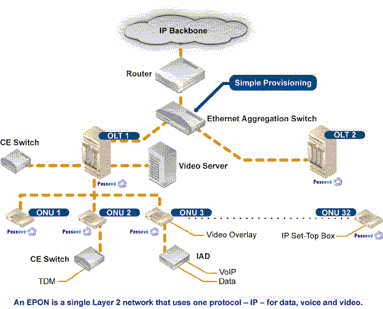
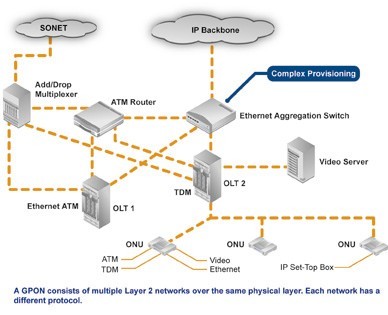
Perhaps the most dramatic distinction between the two protocols is a marked difference in architectural approach. GPON provides three Layer 2 networks: ATM for voice, Ethernet for data, and proprietary encapsulation for voice. EPON, on the other hand, employs a single Layer 2 network that uses IP to carry data, voice, and video.
A multiprotocol transport solution supports the GPON structure (Figure 1). Using ATM technology, virtual circuits are provisioned for different types of services sent from a central office location primarily to business end users. This type of transport provides high-quality service, but involves significant overhead because virtual circuits need to be provisioned for each type of service. Additionally, GPON equipment requires multiple protocol conversions, segmentation and reassembly (SAR), virtual channel (VC) termination and point-to-point protocol (PPP).
Figure 1: Diagram showing a typical GPON network.
EPON provides seamless connectivity for any type of IP-based or other "packetized" "communications" (Figure 2). Since Ethernet devices are ubiquitous from the home network all the way through to regional, national and worldwide backbone networks, implementation of EPONs can be highly cost-effective. Furthermore, based on continuing advances in the transfer rate of Ethernet-based transport — now up to 10 Gigabit Ethernet — EPON service levels for customers are scalable from T1 (1.5 Mbit/s) up through 1 Gbit/s.
Figure 2: Diagram showing a typical EPON network.
Upstream Bandwidth
Subtracting the various system run overhead from the total bandwidth of the system uplink transmission is the upstream available bandwidth. It has a great relationship with the number of the ONU contained in the system, DBA (Dynamic Bandwidth Allocation) algorithm polling cycle, the type of bearer services, as well as the various business proportion. EPON and GPON are broadband access technology, hosted business IP data services. Below we will calculate the uplink the beared pure IP services available bandwidth of EPON and GPON that contain 32 ONUs, fiber optic coupler,the case of polling period 750s.
EPON
EPON upstream rate is 1.25 Gbit/s. Because the 8B/10B line coding, each 10bit are 8bit valid data, so its effective upstream transmission bandwidth is 1 Gbit/s. EPON upstream overhead of running the system and its proportion of the total bandwidth are as following:
1. Used for the the burst reception of physical layer overhead: about 3.5%;
2. Ethernet frame encapsulation overhead: about 7.4%;
3. MPCP (Multi-Point Control Protocol) and OAM operation and management of maintenance protocol overhead: about 2.9%;
4. DBA algorithm resulting in the remaining time slots (that is not sufficient to transfer a complete Ethernet frame time slot) wasted: about 0.6%;
5. EPON upstream total overhead is all of the above about 144 Mbit/s, the available bandwidth is about 856 Mbit/s.
GPON
GPON supports a variety of rate levels, has asymmetric rate that downlink is 2.5Gbps or 1.25Gbps, the upgoing is 1.25Gbps or 622 Mbps. NRZ encoding the uplink total bandwidth for 1.244 Gbit/s, GPON upstream overhead of running the system as following:
1. The proportion of its total bandwidth is used for the the burst reception of physical layer overhead: about 2.0%;
2. GEM (GPON encapsulation method) frame and the Ethernet frame encapsulation overhead: about 5.8%;
3. The PLOAM (physical layer operation, management and maintenance) protocol overhead: about 2.1%;
4. Remaining slots of the DBA algorithm introduced the additional encapsulation overhead: about 0.8%.
5. GPON upstream total overhead is all of the above about 133 Mbit/s, the available bandwidth about 1111 Mbit/s.

Friday, November 29, 2013

Relative Terms In PON System


ODN (Optical Distribution Network)
ODN is a FTTH fiber optic cable network based on PON equipment. Its role is to provide optical transmission channel between the OLT and ONU. Accroding the function, ODN from the central office to the client can be divided into four parts: feeder fiber optic subsystems, cable wiring subsystem, home line of fiber optic subsystems and fiber terminal subsystems. The main components in ODN include optical fibers, optical connectors, optical splitters and corresponding equipments for installing them.
OLT (Optical line terminal)
OLT is a terminal equipment connected to the fiber backbone. It sends Ethernet data to the ONU, initiates and controls the ranging process, and records the ranging information. OLT allocates bandwidth to the ONU and controls the starting time and the transmission window size of the ONU transmission data.
ONU (Optical network unit)
ONU is a generic term denoting a device that terminates any one of the endpoints of a fiber to the premises network, implements a passive optical network (PON) protocol, and adapts PON PDUs to subscriber service interfaces. In some contexts, ONU implies a multiple subscriber device. Optical Network Terminal (ONT) is a special case of ONU that serves a single subscriber.
APON / BPON
APON (ATM PON) is the first PON system that achieved significant commercial deployment with an electrical layer built on Asynchronous Transfer Mode (ATM). BPON (Broadband PON) is the enhanced subsequence of APON, with the transmission speed up to 622Mb/s. At the same time, it added the dynamic bandwidth distribution, protection and other functions. APON/BPON systems typically have downstream capacity of 155 Mbps or 622 Mbps, with the latter now the most common.
GPON
GPON (Gigabit PON) is based on the TU-TG.984.x standard for the new generations of broadband passive optical access. Compared with the other PON standards, GPON provides the unprecedented high bandwidth downlink rate of up to 2.5 Gbit/s, the asymmetric features better adapt to the broadband data services market. It provides the QoS full business protection, at the same time carries ATM cells and (or) GEM frame, the good service level, the ability to support QoS assurance and service access. Carrying GEM frame, TDM traffic can be mapped to the GEM frame, 8kHz using a standard frame able to support TDM services. As a carrier-grade technology standards, GPON also provides access network level protection mechanism and full OAM functions. GPON is widely deployed in FTTH networks. It can develop into two directions which is 10 GPON and WDM-PON.
WDM-PON
WDM-PON uses wavelength division multiplexing technology to access to the passive optical network. It has four programs as following:
1. Each ONU is assigned with a pair of wavelength, for uplink and downlink transmission, thereby providing the OLT to each ONU fixed virtual point-to-point bidirectional connections.
2. ONU uses tunable lasers, according to the needs of the ONU to dynamically allocate the wavelength, and each ONU can be shared the wavelength, the network are reconfigurable.
3. Using colorless ONUs, the ONU are independent from the wavelength.
4. Using a combination of TDM and WDM technology, Composite PON (CPON). CPON uses WDM technology in the downstream, and TDMA technology in the upstream.
EPON / GEPON
EPON (Ethernet PON) is the rival activity to GPON which uses Ethernet packets instead of ATM cells. GEPON uses 1 gigabit per second upstream and downstream rates. It is a fast Ethernet over PONs which are point to multipoint to the premises (FTTP) or FTTH architecture in which single optical fiber is used to serve multiple premises or users. EPON is an emerging broadband access technology, through a single fiber-optic access system, to access the data, voice and video service, and it has a good economy.